

Posted on Date by 13/08/2026
Open Instagram right now. Scroll for thirty seconds.
Notice something? Half the captions sound... the same. "Elevate your everyday." "Unlock your potential." "Because you deserve it." Emoji sparkle here, emoji sparkle there.
That's not a coincidence. That's ChatGPT. That's every brand quietly outsourcing its voice to the same handful of AI tools — and somehow, every single one of them is coming back with the exact same energy.
Here's the wild part: this is actually great news for you.
Because while everyone else is settling for "good enough" AI captions, the brands that crack the code on sounding human are about to stand out more than they have in years. Sameness is the new noise. And you're about to learn how to cut straight through it.
No. Not even close. AI is an incredible tool — it drafts fast, it beats writer's block, it turns a blank cursor into a starting point in three seconds flat. We're not here to cancel it.
But here's what nobody tells you: AI doesn't know your brand. It knows patterns.
It knows that captions "perform" when they follow a formula — hook, value, call to action, emoji. So it gives you the formula. Every time. For every brand. Which means your caption and your competitor's caption are built from the same skeleton, just with different words stapled on.
The result? Content that's technically correct and emotionally invisible.
If your captions have any of these, AI might be driving the whole show:
The "Not just X, but Y" sentence. ("This isn't just a mattress. It's a promise of better sleep.") Everyone's doing it. Everyone.
Question hooks that don't sound like a real question. "Ready to transform your mornings?" Nobody talks like this. Not even in their head.
The em-dash pileup. AI loves em-dashes — it uses them constantly — like this — see what we mean?
Generic positivity with zero specificity. "Amazing." "Incredible." "Game-changing." Says nothing. Means nothing.
Perfectly balanced sentence structures that read like they were written for a TED Talk, not a Tuesday Instagram post.
If you just nodded at two or more of these — don't panic. Almost every brand is guilty. That's exactly why fixing it is such a big opportunity.
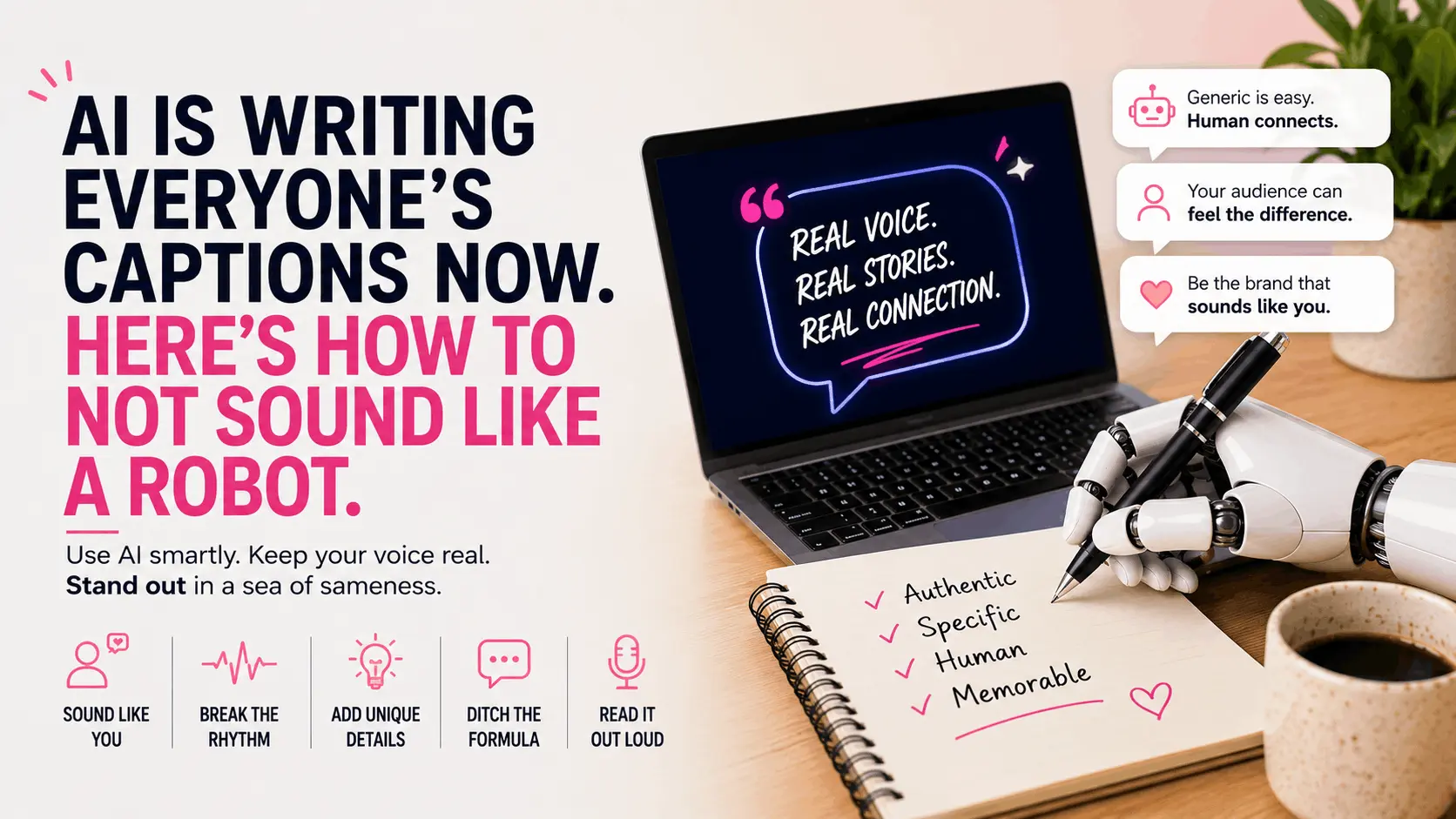
This is the fun part. You don't have to choose between "fast AI content" and "content that sounds like an actual human wrote it." You just need to change how you use the tool.
Don't ask AI to "write an exciting caption." Ask it to write like you — give it three real captions you've written before, your brand's actual tone, even the slang your audience uses. AI mimics patterns. Give it your pattern, not the internet's default one.
Real people don't write in perfectly balanced sentences. They write short punches. Then longer ones that wander a little before landing somewhere. Mix it up. Robots crave symmetry — humans don't.
A specific customer story. An inside joke your community will get. A very oddly specific detail ("we tested this mattress during three consecutive Kolkata power cuts"). AI can't invent your lived experience — but you can layer it in after the draft.
"DM us to know more!" "Link in bio!" — fine, but predictable. Try a CTA that sounds like something a real person would actually say to a friend: "Tell us your worst mattress shopping story below, we'll go first."
This one sounds too simple to work. It works. If it sounds like a corporate voiceover when you say it out loud, it'll read that way too. If it sounds like you talking, post it.
Here's the thing that should genuinely excite you: audiences can feel the difference, even when they can't explain it.
They can't always articulate why one brand's captions make them stop scrolling and another's make them swipe past. But they feel it. Authenticity has a texture. Sameness doesn't.
So while the rest of the internet is out here publishing perfectly optimized, perfectly forgettable AI captions — you get to be the brand that sounds like it's run by actual humans who actually get it. That's not a small advantage. In a feed full of noise that all sounds the same, sounding like yourself is the loudest thing you can do.
AI isn't the enemy. Sameness is. Use the tool, keep the voice, and watch the difference show up in your engagement.
13/08/2026